
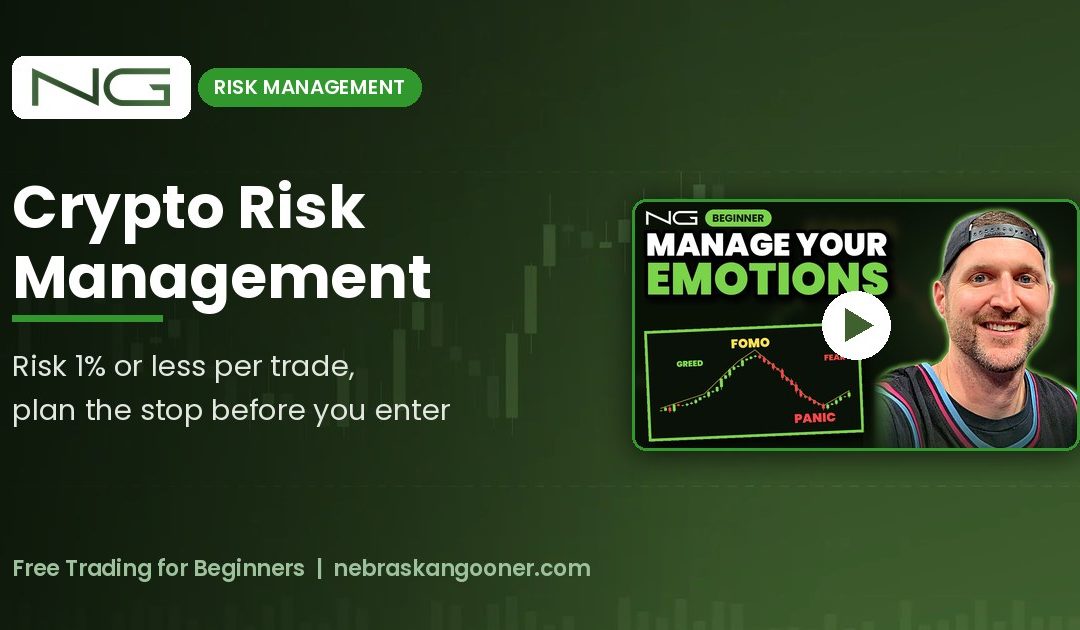
If you only take one thing from all of my free lessons, take this one. You can read candles perfectly and draw every level right, and one oversized trade can still wipe out months of work. Risk management is the part most traders skip, and it is the part that kept me in the game. This is how I approach it, in plain terms.
Start with spot
When you are learning, trade spot. No leverage. With spot, you own the coin, there is no liquidation price, and a bad trade is a loss you can recover from instead of an account that is gone. Leverage multiplies every move, including the ones against you. A 4% move against a 10x position is a 40% loss. Learn to manage risk on spot first. Leverage can wait, and for a lot of people it should wait forever.
Risk 1% or less per trade
Before I enter anything, I decide how much of my account I am willing to lose if the trade is wrong. For a beginner, keep that at 1% or less. That is not 1% of your position. It is 1% of your whole account, measured from your entry to your stop loss.
Here is the math. Say your account is $5,000. One percent is $50. You want to buy at $100 and your stop is at $95, which is 5% below your entry. Your position size is $50 divided by 5%, which is $1,000. If the stop hits, you lose about $50 and you still have $4,950 to work with.
Notice that the stop decides the size, not the other way around. If your stop needs to be 10% away, your position gets smaller. A lot of people use the same size every time no matter where the stop is, and that is how one trade ends up costing them 20% of the account.
Cap your total open risk
I set a total risk tolerance for the whole account and call it 1R. Before any new trade I add up the risk on everything already open. One position can use the full 1R, or two positions can use half each, or three can use a third each. If I am already at my full 1R and want a new trade, I either pass or tighten the stops on what is open to free up room. This stops five “small” trades from quietly adding up to one big bet.
Why it matters: losing streaks
You are going to have losing streaks of four, five, six trades in a row. Everyone does. If you risk 20% per trade, three losses in a row take a $5,000 account under $2,600. If you risk 1% per trade, five losses in a row leave you around $4,750, and you are still in the game with a clear head. Small drawdowns are what matter most to me.
Plan the trade before you enter
Every trade gets a plan before the order goes in: where I enter, where the idea is wrong, and where my target is. If you enter a random trade and price moves against you, you will not know where to get out, and you will end up holding and hoping. Hope does not do anything for you. If you are searching for reasons a trade will work, you are probably wrong.
Do not put your stop right below the most obvious wick on the chart. That is the newbie stop and it gets hunted. Give it a little room past the obvious level and make the position smaller so the risk stays at 1%.
Use alerts instead of staring at charts
Once your levels are drawn, set price alerts on them and walk away. You do not need to watch every candle. Staring at the chart is how you talk yourself into a trade that is not there yet, or out of a good one too early. When the alert fires, come back, check the close, and follow your plan.
This also helps with FOMO. If you missed a move, do not chase it into resistance. Put it on your watch list, wait for a close above resistance, and buy the retest. Paying a couple percent higher after a confirmed breakout is better than buying the top of a rejection.
No revenge trades
If you just took a loss and you are angry at the market, turn the charts off. Go do something else. Nobody wins revenge trading. You stop thinking critically, you size up to win it back, and that is how a small loss turns into a big one. A loss you planned for should not be stressful. You already accepted it when you set the stop.
The same goes for days you are tired or not feeling it. I have had days where my brain felt like jello, and the right move was to trade tiny or not at all. Taking time off is fine. A friend of mine stepped away for a month after the market rattled him, and that was the right call.
A short checklist
- Spot first. No leverage while you are learning.
- Risk 1% or less of your account per trade.
- Size the position from the distance to your stop.
- Keep total open risk under your 1R.
- Plan entry, invalidation and target before you click buy.
- Set alerts at your levels and step away.
- Never revenge trade. Turn the charts off instead.
- Never trade money you cannot afford to lose.
If you want the chart side of this, start with How to Read Candlestick Charts and Support and Resistance for Beginners. I also have a video on how I manage my money on YouTube.
Keep learning
All of my free lessons, including the #TAtip chart breakdowns from X, are on the Free Content page. The full Trading for Beginners playlist and my other videos are on the Videos page.
If you want to see how I put this into practice, the Crypto Portfolio Tracker is my private Telegram group where I post my entries and exits, stop losses and market updates in text. It is there to learn from, not a promise of results.
Not financial advice. This post is for educational purposes only. Trading crypto is risky and you can lose some or all of your money. Do your own research and make your own decisions.